
Original Stained Glass Guide 2026: Types, Designs, Uses, Cost Factors and Buying Advice
Looking for an original stained glass design for your home, office, entrance, door, window or interior project? This complete 2026 guide explains what stained glass is, how it is made, the different styles available, where it works best, what affects its price, and how to choose a design that looks beautiful without ignoring privacy, light, maintenance or installation requirements.
Stained glass is no longer limited to traditional religious buildings or historic architecture. In modern residential and commercial interiors, decorative coloured and patterned glass can become a feature that changes the character of an ordinary space. A carefully designed panel can introduce colour, filter views, create privacy, highlight an entrance or simply turn natural light into part of the interior design.
At Glassinium, we look at stained glass as more than a decorative product. The best result depends on the relationship between design, glass selection, light direction, dimensions, surrounding frame and the purpose of the space.
This guide will help you understand those decisions before choosing an original stained glass design.
What Is Stained Glass?
Stained glass is decorative glass that uses colour, texture, painting, cutting or multiple pieces of glass to create a visual design. Traditional stained glass often consists of individual coloured or painted pieces joined together with metal cames, while modern architectural art glass may use a wider range of materials and fabrication techniques.
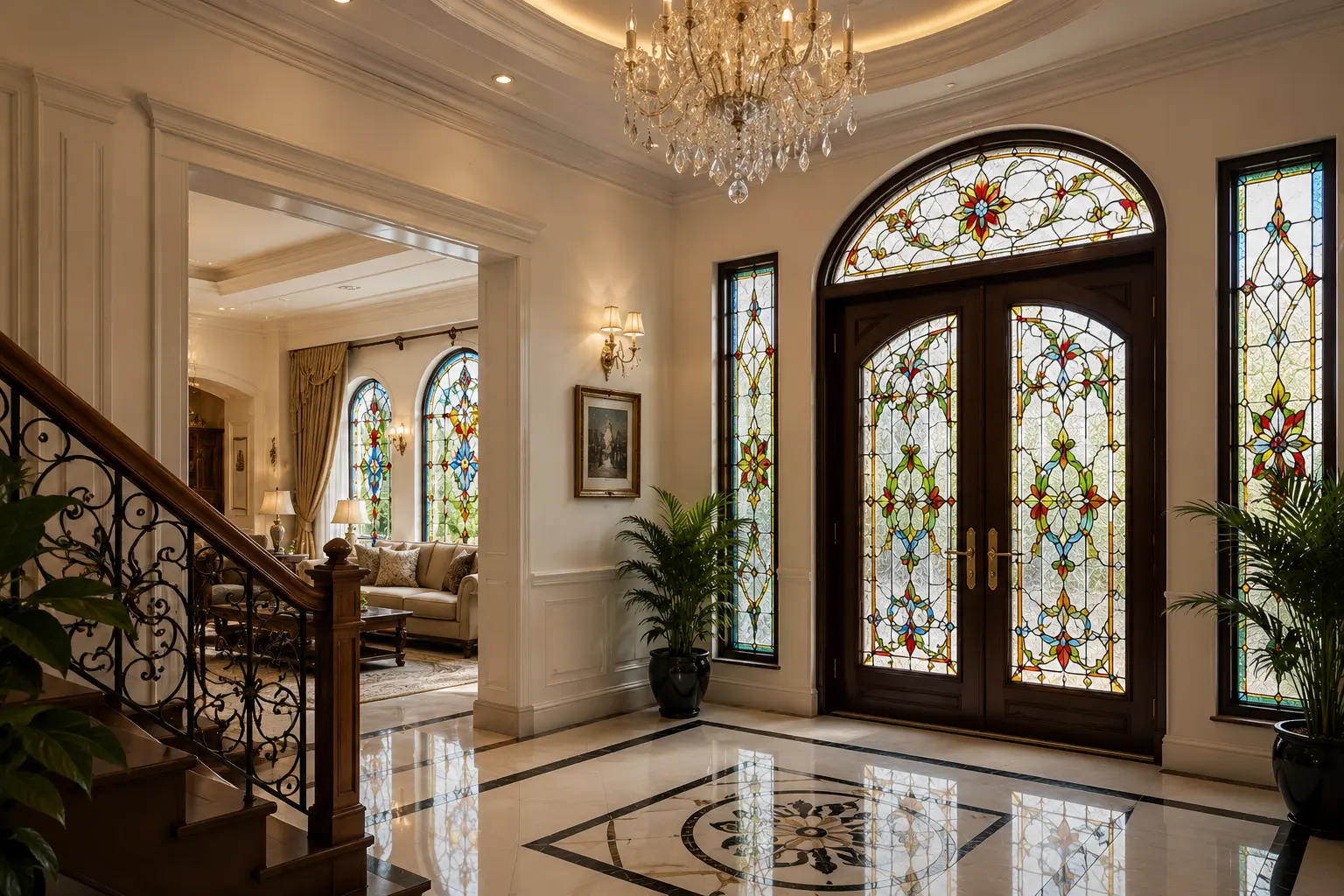
Historically, stained glass has been associated with coloured glass panels held together by lead strips, although decorative architectural glass today can include leaded, painted, textured, opalescent and other art-glass approaches.
The important question for a modern project is not simply:
“Which stained glass design looks nice?”
A better question is:
“Which design will look right in this specific space, under this light, with this level of privacy and maintenance?”
That difference can completely change the final result.
Why Is Stained Glass Still Relevant in 2026?
Modern architecture often uses clean walls, large openings, aluminium frames and extensive glazing. While these elements create openness, they can sometimes make interiors feel visually similar.
Original stained glass provides a way to introduce identity without relying entirely on furniture, wall décor or artificial lighting.
A well-planned stained glass feature can help with:
- Adding visual character to an entrance
- Creating decorative privacy
- Softening direct views
- Introducing controlled colour into natural light
- Making doors and windows more distinctive
- Creating a focal point in staircases and hallways
- Separating spaces without building a solid wall
- Complementing modern, traditional or transitional interiors
- Giving a custom-built property a more individual appearance
The effect changes throughout the day because stained glass interacts with available light. This relationship between colour, transparency and changing light is one of the characteristics that has made stained glass significant in architecture for centuries.
Types of Stained Glass
Not every stained glass panel is made or designed in the same way. Understanding the main categories can help you explain your requirements more clearly when requesting a custom design.
1. Leaded Stained Glass
Leaded stained glass is one of the most recognised traditional forms.
Individual pieces of glass are cut according to a pattern and assembled using metal channels, commonly called cames. The network of joining lines becomes part of the visual design rather than something hidden.
This style works particularly well for:
- Traditional doors
- Heritage-inspired homes
- Decorative windows
- Feature panels
- Religious architecture
- Classic interior spaces
The Stained Glass Association of America describes leaded stained glass as coloured or decorative glass assembled using lead cames, while related forms can include painted and other art-glass techniques.
2. Art Glass
Art glass focuses more heavily on artistic expression.
Depending on the project, the design may combine colour variation, texture, painted details and specially selected glass to create a more expressive result.
This approach can be suitable when the client wants:
- A unique feature window
- Artistic floral patterns
- Abstract compositions
- Landscape-inspired artwork
- Custom motifs
- A one-of-a-kind interior feature
The final appearance depends heavily on the quality of the design process because the same colour palette can look completely different when the glass texture, light source or surrounding materials change.
3. Textured Decorative Glass
Some projects do not require strong colours or complex artwork.
Textured decorative glass can provide a quieter alternative. The surface pattern changes how light and views pass through the glass, which can make it useful where privacy is important but natural light is still desired.
Common applications include:
- Bathroom windows
- Internal doors
- Entrance sidelights
- Office areas
- Staircases
- Room dividers
This type of glass can be especially useful when the objective is privacy first and decoration second.
4. Opalescent Glass
Opalescent glass has a softer, often milky or less transparent appearance compared with clear coloured glass.
It can create depth and colour variation even when the opposite side of the panel is not clearly visible.
This makes it useful for designs where:
- Privacy is important
- A softer appearance is preferred
- Strong transparency is not required
- The design needs visual depth
5. Painted Stained Glass
Painted glass allows additional lines, shading and decorative details to be added to the glass surface.
It is particularly useful when the design requires more detail than cut glass pieces alone can provide.
Examples may include:
- Floral artwork
- Faces or figures
- Architectural motifs
- Detailed borders
- Traditional decorative scenes
- Custom illustrations
Historically, painted details have played an important role in stained glass, allowing linework and shading to add complexity to a composition.
6. Modern Geometric Stained Glass
For contemporary homes, geometric stained glass is often easier to integrate than highly traditional artwork.
Instead of detailed pictures, the design may use:
- Straight lines
- Arches
- Rectangles
- Circles
- Repeating patterns
- Minimal colour combinations
- Abstract compositions
A geometric approach can work particularly well with modern aluminium windows and doors because it can visually connect with the clean lines of contemporary architecture.
Internal link opportunity: Add a relevant contextual link here to your Aluminium Windows service page.
Where Can Stained Glass Be Used?
One of the advantages of custom decorative glass is that it can be adapted to many architectural locations.
Stained Glass for Main Entrance Doors
The main entrance is often the first architectural element visitors notice.
A stained glass panel can be incorporated into or around a door to create a stronger first impression.
When selecting a design for an entrance, consider:
- Privacy from the street
- Amount of natural light required
- Door material and frame style
- Security requirements
- Scale of the entrance
- Exterior colour scheme
For many homes, a design that looks beautiful from inside but exposes too much of the interior may not be practical. Therefore, privacy should be considered at the design stage rather than after installation.
Stained Glass Windows
Stained glass windows can turn ordinary openings into architectural features.
Possible locations include:
- Living rooms
- Staircases
- Bedrooms
- Hallways
- Bathrooms
- Dining areas
- Double-height spaces
- Feature walls
The best design depends strongly on window orientation and available daylight.
A heavily coloured panel may appear rich and vibrant in one location but much darker in another. Before finalising a design, it is useful to consider where the strongest natural light enters the building.
Internal link opportunity: Link the phrase custom glass windows or aluminium windows in Lahore to the relevant Glassinium service page.
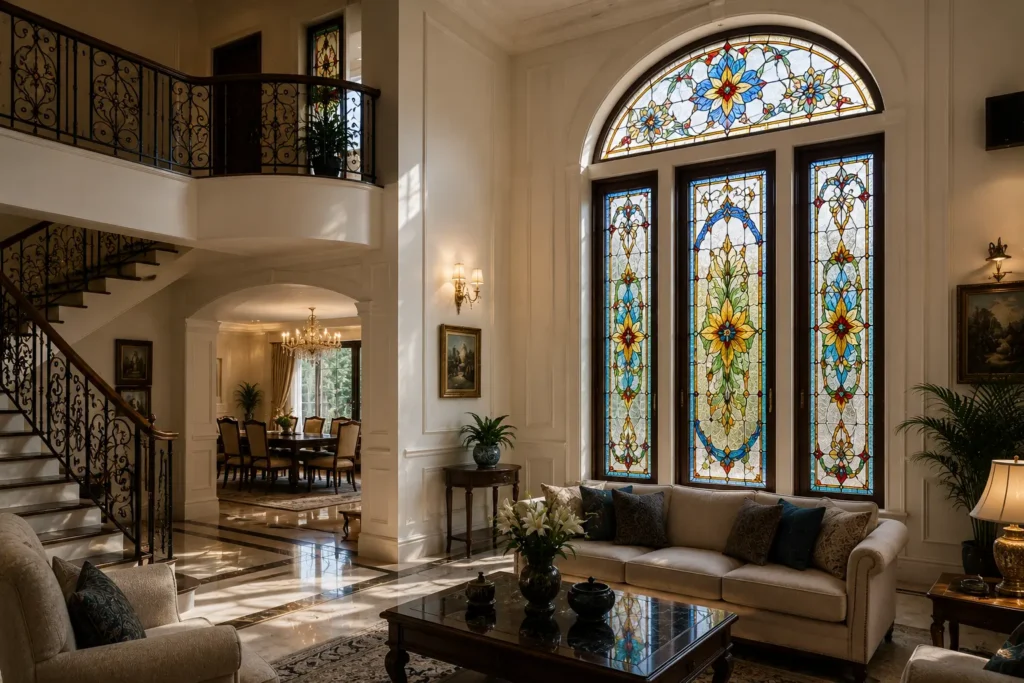
Stained Glass for Staircases
Staircases often contain tall vertical windows or otherwise unused wall areas.
This makes them particularly suitable for decorative glass.
A vertically oriented design can:
- Emphasise height
- Bring colour into a central circulation area
- Create a feature visible from multiple floors
- Improve the appearance of an otherwise plain staircase
For large staircase windows, the design should be considered from both close and distant viewing positions.
Stained Glass for Bathrooms
Bathrooms often require a balance between light and privacy.
Decorative or textured glass can help bring daylight into the room while reducing direct visibility.
The design should consider:
- Privacy level
- Moisture exposure
- Ease of cleaning
- Window location
- Surrounding finishes
For bathroom renovation projects, stained or decorative glass can also complement a modern glass shower cabin.
Internal link opportunity: Add a contextual link to the Glassinium Glass Shower Cabins page.
Stained Glass for Offices and Commercial Spaces
Stained or decorative glass is not only for residential projects.
In commercial interiors, it can be used for:
- Reception features
- Meeting rooms
- Decorative partitions
- Hospitality spaces
- Restaurants
- Boutique stores
- Salons
- Corporate interiors
A commercial project may benefit from a more subtle design that supports branding rather than dominating the entire space.
Internal link opportunity: Link to your Glass Partitions page where relevant.
How to Choose the Right Stained Glass Design
Choosing from a catalogue alone is not always enough.
The same design can produce very different results depending on the building.
Use the following process.
Step 1: Define the Purpose
First decide what the glass needs to achieve.
Is the main objective:
- Decoration?
- Privacy?
- Natural light?
- Branding?
- A traditional appearance?
- A modern architectural feature?
The answer should influence the design.
For example, a bathroom window and a grand entrance window should not automatically be designed according to the same criteria.
Step 2: Consider the Amount of Natural Light
Stained glass depends heavily on light.
Before choosing darker colours or dense patterns, consider:
- Which direction the window faces
- Whether another building blocks the light
- Whether the room is naturally bright
- Whether the glass is an interior or exterior feature
A design that appears bright in a showroom image may look significantly different after installation in a darker location.
Step 3: Match the Architectural Style
The design should have a relationship with the building.
For modern homes:
Consider:
- Geometric patterns
- Neutral colours
- Limited colour palettes
- Clean lines
- Abstract artwork
For classic interiors:
Consider:
- Floral designs
- Traditional borders
- Symmetrical patterns
- Richer colours
- More detailed compositions
For luxury interiors:
Consider a custom composition based on:
- Marble patterns
- Interior colour palette
- Metal finishes
- Lighting design
- Furniture style
The goal should be coordination, not simply decoration.
Step 4: Decide How Much Privacy You Need
This is one of the most important practical questions.
A beautiful transparent design may not be suitable for every location.
Consider whether people outside should be able to:
- See shapes only
- Partially see through
- Clearly see through
The required privacy level can influence the choice of texture, colour density and glass composition.
Step 5: Think About Viewing Distance
A detailed design may look excellent up close but become visually confusing when viewed from across a large room.
For large windows, the overall composition should remain understandable from a distance.
For small panels, fine details may be more appropriate.
Original Stained Glass Design Ideas for 2026
1. Minimal Geometric Designs
Simple lines and carefully selected colours can create a premium appearance without making the window feel busy.
Best for:
- Modern villas
- Contemporary offices
- Aluminium-framed windows
- Minimalist interiors
2. Islamic Geometric Patterns
Geometric patterns inspired by traditional Islamic design can work beautifully in:
- Entrances
- Feature windows
- Mosques
- Majlis spaces
- Luxury homes
A modern interpretation can use simplified geometry rather than copying an overly complex historical pattern.
3. Floral Stained Glass
Floral designs remain popular because they can soften rigid architectural lines.
They work particularly well in:
- Traditional homes
- Dining areas
- Staircase windows
- Decorative doors
The colour palette should be controlled carefully. Too many unrelated colours can make a custom piece look less refined.
4. Abstract Colour Compositions
Abstract designs allow greater freedom.
Instead of representing an object, the composition may focus on:
- Movement
- Colour balance
- Light
- Texture
- Geometry
This can be an excellent option for homeowners who want something original rather than a standard catalogue pattern.
5. Nature-Inspired Designs
Possible themes include:
- Leaves
- Trees
- Water
- Mountains
- Flowers
- Birds
The design can be realistic or highly simplified depending on the architectural style.
6. Monochromatic Stained Glass
Stained glass does not always need many colours.
A design built around one primary colour family can create a sophisticated appearance.
Examples:
- Different shades of blue
- Green variations
- Amber and gold tones
- Neutral frosted combinations
This approach can work particularly well in modern interiors.
How Is Custom Stained Glass Made?
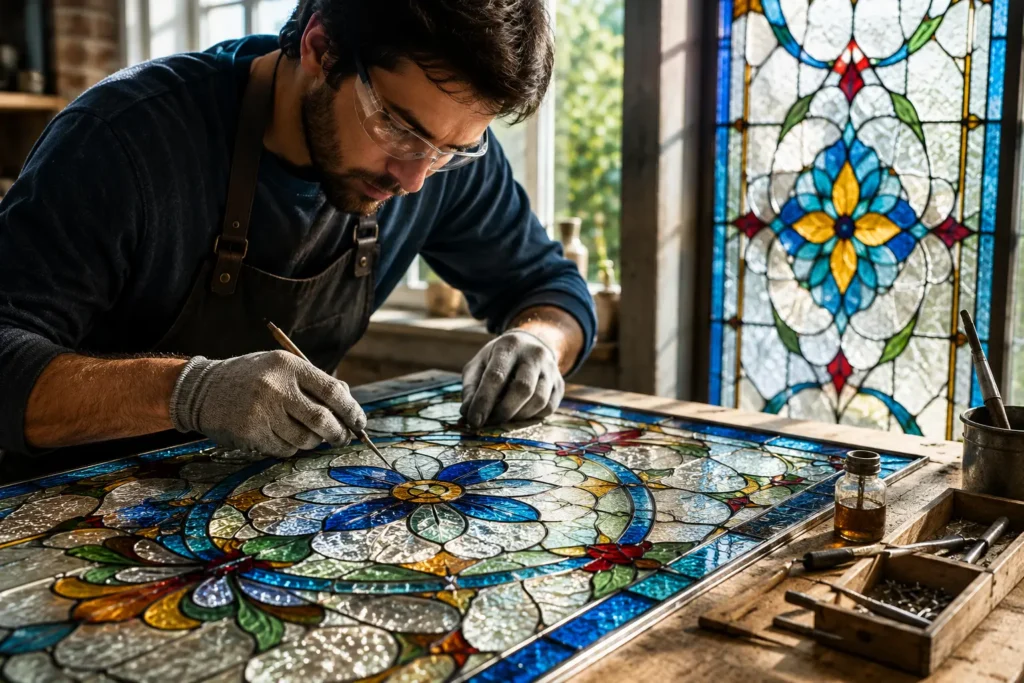
The exact production method depends on the type of glass and design, but a typical custom project may involve the following stages.
1. Requirement Discussion
The process begins by understanding:
- Installation location
- Required dimensions
- Design preference
- Privacy requirements
- Existing architecture
- Budget expectations
2. Design Development
A concept is created based on the available space and the intended visual result.
This stage is important because changing a design before fabrication is usually easier than changing it after production.
3. Glass and Material Selection
The selected materials influence:
- Colour
- Transparency
- Texture
- Visual depth
- Privacy
- Maintenance requirements
4. Cutting and Assembly
The individual components are prepared according to the approved design and assembled using the appropriate method for that project.
Traditional stained glass can involve multiple pieces joined into a larger composition using metal cames or other construction techniques.
5. Finishing and Installation
The finished panel must be properly integrated into its frame or architectural opening.
Installation quality matters because the surrounding frame, weather exposure, structural support and environmental conditions can all affect long-term performance. Preservation guidance for stained glass also highlights the importance of the overall building environment, moisture and weather exposure.
What Affects the Price of Stained Glass?
There is no single universal price for custom stained glass because each project can have different requirements.
The final cost may depend on:
Size
Larger panels generally require more material, fabrication time and installation planning.
Design Complexity
A simple geometric pattern may require fewer individual components than a highly detailed custom composition.
Type of Glass
Special textures, colours and art glass can affect material costs.
Fabrication Method
Different construction techniques require different levels of labour and craftsmanship.
Custom Artwork
An original design created specifically for a project may require additional design development.
Frame and Installation
The cost can also depend on whether the glass is being installed into:
- A new aluminium frame
- An existing window
- A door
- A partition
- A specially designed architectural feature
Site Conditions
Height, accessibility and installation complexity can also influence project planning.
The Best Way to Request a Stained Glass Quote
For a more accurate quotation, provide:
- Approximate width and height
- Installation location
- A photo of the existing area
- Preferred design style
- Required privacy level
- Whether a frame is already available
This gives the design and installation team a clearer starting point.
Is Stained Glass Durable?
Yes, a properly designed and maintained stained glass installation can have a long service life, but durability depends on the materials, construction, environment and maintenance.
Historic stained glass demonstrates that the material can survive for very long periods, but it is also vulnerable to factors such as weather, pollution, condensation, structural movement and deterioration of surrounding components.
For modern projects, durability should be discussed in relation to the actual installation environment rather than making a one-size-fits-all promise.
How to Maintain Stained Glass
Maintenance requirements depend on the type and age of the glass.
For valuable, historic or highly detailed stained glass, specialist advice is particularly important.
General care principles include:
- Inspect the glass periodically
- Look for cracks or loose sections
- Check surrounding frames
- Watch for moisture or condensation problems
- Avoid aggressive or abrasive cleaning
- Do not use harsh cleaning methods on delicate painted surfaces
- Seek professional help when structural or decorative deterioration is visible
The U.S. National Park Service recommends careful inspection and gentle cleaning practices for stained glass, noting that aggressive treatment can create additional damage, particularly with painted or delicate glass.
Historic England similarly identifies rain, wind, pollution and condensation as environmental factors that can contribute to deterioration.
Common Mistakes to Avoid When Choosing Stained Glass Pakistan
Choosing Only From a Picture
A design image does not show exactly how the panel will react to the light inside your property.
Always consider the actual installation location.
Ignoring Privacy
A design may look attractive but provide less privacy than expected.
Using Too Many Colours
More colours do not automatically create a better result.
A controlled palette can often look more premium.
Ignoring the Frame
The surrounding aluminium, wood or other frame is part of the final appearance.
The glass should work with the frame instead of competing with it.
Choosing Detail That Is Too Small
Very fine details may not be visually effective at a large viewing distance.
Forgetting Maintenance
A design should be selected with realistic long-term care requirements in mind.
Stained Glass vs Decorative Glass: What Is the Difference?
The terms are sometimes used broadly, but they are not always interchangeable.
Stained glass generally refers to coloured, painted or artistically assembled glass, often involving individual pieces arranged to form a design.
Decorative glass is a broader category that can include:
- Patterned glass
- Frosted glass
- Textured glass
- Etched glass
- Printed glass
- Coloured glass
- Other architectural decorative treatments
The best choice depends on the project.
Choose stained glass when:
- You want an artistic feature
- Colour and design are major priorities
- The window itself should become a focal point
- You want a custom composition
Choose simpler decorative glass when:
- Privacy is the main goal
- A subtle appearance is preferred
- The architecture is highly minimal
- The budget or design scope does not require a complex artwork
Are Stained Glass Windows Suitable for Modern Homes?
Yes. Modern stained glass does not need to look traditional.
A contemporary design can use:
- Clean geometry
- Limited colours
- Neutral tones
- Large simple shapes
- Abstract patterns
- Custom compositions based on the architecture
The key is to design the glass for the building rather than selecting a historical pattern and placing it into an unrelated modern setting.
Why Custom Design Is Better Than a Generic Pattern
A generic design is created for a broad audience.
A custom stained glass design can consider:
- Exact window dimensions
- Interior colours
- Exterior architecture
- Natural light direction
- Privacy requirements
- Existing doors and windows
- Personal style
This creates an opportunity for the glass to feel integrated with the property instead of appearing as an added decoration.
Stained Glass for Homes in Lahore: What Should You Consider?
For projects in Lahore, the design process should consider the actual conditions of the property rather than focusing only on appearance.
Important factors may include:
- Window orientation
- Amount of sunlight
- Privacy from neighbouring properties
- Building style
- Existing aluminium or glass systems
- Indoor and outdoor exposure
- Ease of maintenance
A site-specific discussion is usually more useful than selecting a design solely because it looked attractive in another property.
For homeowners planning a wider renovation or construction project, stained glass can also be coordinated with other architectural glass elements such as aluminium windows, glass partitions, glass railings and shower cabins.
Internal linking opportunity: Use this paragraph to link naturally to the relevant Glassinium service pages rather than placing unrelated links in a separate list.
How Glassinium Can Help With Custom Stained Glass Projects
At Glassinium, the starting point should be your space and requirement—not a one-size-fits-all design.
A custom stained glass project can begin with:
- Understanding your location and dimensions
- Reviewing the installation area
- Discussing design preferences
- Considering privacy and light
- Selecting an appropriate style
- Planning the surrounding frame and installation
Whether you are planning a feature window, entrance glass, staircase panel, decorative interior element or a completely original design, the goal should be to create a solution that fits the architecture and remains visually meaningful after installation.
Glassinium provides custom glass and aluminium solutions for residential and commercial spaces in Lahore and other areas of Pakistan. Explore the main range of services on the Glassinium official website.
Frequently Asked Questions About Stained Glass
What is stained glass used for?
Stained glass is used for decorative windows, doors, entrances, staircases, partitions, religious architecture and interior feature panels. It can add colour, privacy and visual character while still allowing light to interact with the space.
Can stained glass provide privacy?
Yes. The level of privacy depends on the glass type, colour, texture and design. A project can be designed for partial or higher visual privacy depending on the installation location.
Is stained glass suitable for modern houses?
Yes. Modern stained glass can use minimal colours, geometric patterns, abstract designs and clean lines that complement contemporary architecture.
How long does stained glass last?
Its lifespan depends on materials, construction quality, environmental exposure and maintenance. Historic examples show that stained glass can survive for very long periods, but moisture, pollution, weather and structural issues can cause deterioration.
Is stained glass difficult to maintain?
Routine care is generally manageable, but delicate, painted, historic or damaged stained glass requires careful treatment. Abrasive cleaning and aggressive chemicals should be avoided unless the specific material and method are known to be suitable.
Can I order a completely original stained glass design?
Yes. A custom project can be designed around your dimensions, architectural style, preferred colours, privacy requirements and intended installation location.
What information is needed for a stained glass quotation?
Providing approximate dimensions, photographs of the installation area, location, design preferences and privacy requirements can help create a more relevant estimate.
Is stained glass only used in windows?
No. It can also be incorporated into doors, partitions, sidelights, interior features and other architectural applications.
Final Thoughts: The Best Stained Glass Design Is the One Designed for Your Space
The right stained glass is not simply the most colourful or complicated design.
A successful project brings together:
- Original design
- Appropriate glass selection
- Natural light
- Privacy
- Architecture
- Quality fabrication
- Correct installation
- Long-term maintenance considerations
If you are searching for original stained glass designs, custom stained glass windows or decorative glass solutions in Lahore, start by looking at the actual space where the glass will be installed.
A good design should look intentional from every important angle—and should continue to add character to the property long after the installation is complete.
Contact Glassinium to discuss your custom stained glass requirements and explore a design based on your own space, dimensions and style.
Visit Us Our Latest Products
Naturally add contextual links to relevant existing pages:
- Aluminium Windows → Link from the section discussing modern window integration.
- Glass Partitions → Link from the commercial and office applications section.
- Glass Shower Cabins → Link from the bathroom applications section.
- Glass Railings → Mention naturally in the section discussing coordinated architectural glass design.
- Glass Cut Work Designs → Link when discussing decorative and custom glass artwork.
- Company → Best Glass and Aluminium Work Lahore.
Suggested Authoritative References
For additional trust and E-E-A-T value, these sources can be linked contextually where they genuinely support the information:
- Stained Glass Association of America – History and Types of Stained Glass
- Historic England – Looking After Stained Glass Windows
- U.S. National Park Service – Preservation Matters: Stained Glass
- V&A – An Introduction to Stained Glass
———————————————
Published: August 18, 2026
Written by: Faseeh Hussain (Glassinium Editorial Team)
Reviewed by: Glassinium Technical Team
One Comment